.png)
Agiary (The Fire Temple)
The consecrated place of worship where the sacred fire is kept perpetually burning by priests, symbolizing divine light.
One of the world's oldest continuously practiced religions. Founded by Prophet Zoroaster in ancient Persia, it centers on the cosmic struggle between good and evil, guiding humanity toward righteous actions.
Following the Arab conquest of Persia, a group of Zoroastrians migrated to India to protect their faith and sacred traditions. Landing on the shores of Gujarat, they became known as the 'Parsis'. They integrated beautifully into Indian society, contributing significantly to its growth while preserving their unique cultural roots.
Zoroastrianism is strictly monotheistic. God is worshiped as Ahura Mazda, meaning the 'Wise Lord'. He is the ultimate source of all goodness, truth, light, and wisdom in the universe.
Asha is the foundational law of righteousness, cosmic order, and ultimate truth. Living in accordance with Asha means maintaining natural balance, honesty, and moral integrity.
The universe involves a moral battle between Spenta Mainyu (the holy, creative spirit) and Angra Mainyu (the destructive, chaotic spirit). Humanity acts as crucial allies to overcome evil through righteousness.
Humans are endowed with rational thinking and complete free will. Every individual is completely responsible for choosing their path—either contributing to cosmic order or supporting chaos.
Fire is not worshiped as a god, but acts as the supreme symbol of Ahura Mazda’s presence, absolute purity, energy, and the light of truth inside every living being.
Zoroastrianism deeply values ecological sanctity. Defiling pure natural elements—such as water, soil, air, and vegetation—is considered an act against the divine design.
The consecrated place of worship where the sacred fire is kept perpetually burning by priests, symbolizing divine light.
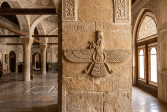
The most famous symbol of Zoroastrianism, representing the personal spirit (Fravashi), wisdom, and the soul's continuous progression.
.png)
Traditional circular structures designed for sky burials, safely returning the physical form to nature without defiling water or soil.
